

Makeup Sponge vs Brush for Foundation: Which Wins?
Table of Contents
- Makeup Sponge vs Brush for Foundation: The Quick Comparison
- Pros and Cons of Makeup Sponges
- Pros and Cons of Foundation Brushes
- Coverage, Finish, and Product Waste: How Each Tool Performs
- Makeup Sponge Benefits for Dry Skin and Other Skin Types
- The Best Foundation Brush for Liquid Foundation (and When to Reach for a Sponge)
- How to Clean Makeup Brushes and Sponges (and How Often)
- Conclusion
- Frequently Asked Questions
Last Updated: September 19, 2026
Makeup Sponge vs Brush for Foundation: The Quick Comparison
The makeup sponge vs brush for foundation debate comes down to one trade-off: sponges give you a skin-like, streak-free finish at the cost of soaking up product, while brushes deliver faster, more buildable coverage with less waste but demand better technique. At Cosmetikly, we've watched this single choice reshape entire beauty routines, and the answer depends far less on trends than on your skin type, your foundation formula, and how much time you actually have in the morning. Below, we break down exactly when each tool wins, plus the hygiene habits that keep both working for months.

Here's the short version: reach for a damp sponge when you want a sheer, pore-blurring, airbrushed effect; reach for a brush when you want full coverage fast.
| Factor | Makeup Sponge | Foundation Brush |
|---|---|---|
| Finish | Skin-like, airbrushed | Smooth, buildable |
| Coverage | Sheer to medium | Medium to full |
| Product absorption | High | Low |
| Best skin type | Dry, mature | Oily, combination |
| Speed | Slower | Faster |
| Cleaning | Daily rinse, weekly wash | Weekly wash |
Pros and Cons of Makeup Sponges
A makeup sponge is a porous blending tool, usually made of foam, that applies and presses foundation into the skin for a seamless, natural-looking finish. Its biggest strength is blendability: a damp sponge softens edges, blurs pores, and creates that airbrushed effect that's hard to fake with fingers.
The catch is product absorption. Porous foam drinks up liquid foundation, so you use more per application. Sponges also need frequent cleaning because bacteria thrive in damp foam.
- Pros: flawless finish, streak-free application, gentle on sensitive skin, reaches contours
- Cons: absorbs product, needs daily maintenance, wears out faster than brushes
- Best for: dry skin, sheer coverage, a skin-like finish
Pros and Cons of Foundation Brushes
A foundation brush is a tool with synthetic bristles designed to buff, stipple, or sweep foundation across the skin. The best foundation brush for liquid foundation uses dense, soft synthetic bristles that won't soak up water-based formulas the way natural hair can.
Brushes waste less product and build coverage faster. The trade-off is technique: a heavy hand leaves streaks, and stiff bristles can irritate reactive skin.
- Pros: minimal product absorption, buildable coverage, long-lasting tool, quick application
- Cons: requires practice, can streak if used wrong, needs weekly deep cleaning
- Best for: oily skin, full coverage, busy mornings
Coverage, Finish, and Product Waste: How Each Tool Performs
Coverage and finish are where the two tools diverge most, and the reason comes down to mechanics. A sponge works by pressing and bouncing foundation into the skin. That pressing action pushes product into pores and fine lines rather than sitting it on top, which is why the result reads as sheer, buildable, and skin-like. A brush works by buffing and stippling product across the surface. The bristles distribute foundation in a thin, even layer that builds up faster, which is why brushes deliver fuller coverage with a smoother, more polished texture.
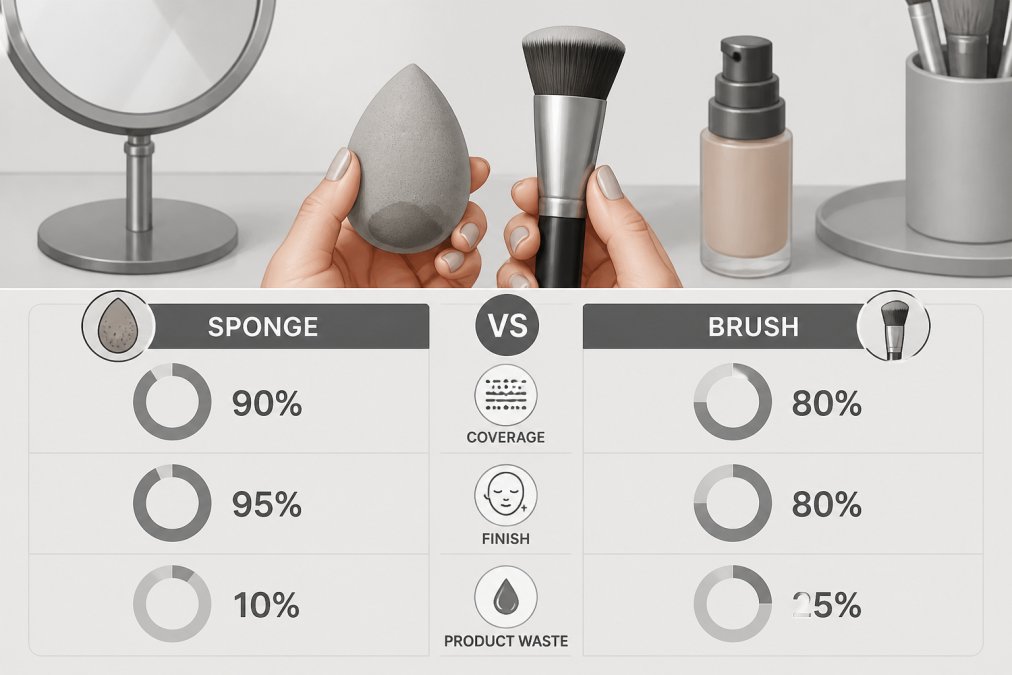
How coverage actually builds:
- Sponge: Start with a thin layer and bounce more on for medium coverage. Because each pass presses product in, you can layer without it looking heavy, but you'll use more product to get there.
- Brush: A stippling brush can sheer out a full-coverage formula, while a dense buffing brush can push a light formula toward medium-full. The brush gives you more control over the final intensity.
The product-waste mechanism: Porous foam absorbs liquid. When you pump foundation onto a sponge, a meaningful share of that pump soaks into the foam instead of reaching your face, which is why a bottle of liquid foundation tends to run out faster when you apply with a sponge. The exact amount varies by sponge density and how damp it is, but the pattern is consistent: sponges waste more, brushes waste less. A damp sponge absorbs less than a dry one, which is one more reason to always use it damp.
Formula matters as much as tool:
- Water-based liquid foundation: A damp sponge blends it beautifully; a synthetic brush also works well and wastes less.
- Silicone-based or long-wear foundation: A brush gives more control and prevents the formula from breaking down against a wet sponge.
- Cream foundation: A sponge wins on blendability, the pressing motion melts cream into the skin.
- Powder foundation: A brush is the clear choice; a sponge will cake and absorb the powder unevenly.
For cream products, a sponge wins on blendability. For liquid foundation and powder, a brush gives you more control over texture enhancement.
Makeup Sponge Benefits for Dry Skin and Other Skin Types
Makeup sponge benefits for dry skin are real: the pressing motion lays down hydration-friendly coverage without dragging across flaky patches. Damp application also prevents the cakiness that dry skin develops with buffing brushes.
The Best Foundation Brush for Liquid Foundation (and When to Reach for a Sponge)
The best foundation brush for liquid foundation has dense, synthetic bristles, a flat or slightly domed head, and an ergonomic handle for controlled buffing. Synthetic bristles work best with water-based formulas because they don't absorb water the way natural hair does.
How to Clean Makeup Brushes and Sponges (and How Often)
Step-by-step for brushes:
- Rinse the bristles under lukewarm water, keeping the ferrule and handle out of the stream, water seeping into the ferrule breaks down the glue and shortens the brush's life.
- Work a small amount of gentle cleanser or brush shampoo into the bristles using circular motions in your palm.
- Rinse until the water runs clear, then gently squeeze out excess water.
- Reshape the bristles and lay the brush flat to dry with the head slightly lower than the handle, or stand it bristle-down in a drying rack. Never dry bristle-up, water runs into the ferrule.
Step-by-step for sponges:
- Wet the sponge and work in a drop of mild soap or baby shampoo.
- Squeeze and knead until the water runs clear, this can take several rounds if the sponge is heavily saturated.
- Squeeze out as much water as possible, then let it air-dry fully on a clean surface or a ventilated sponge holder.
The sustainability angle most guides skip: Disposable and low-cost foam sponges are replaced frequently, which adds up to a steady stream of landfill waste. A high-quality synthetic brush, used and cleaned correctly, can replace dozens of sponges over its lifetime. If reducing waste matters to you, a brush is the lower-impact long-term choice, and when you do buy sponges, washing them properly and replacing them only when they break down extends each one's usable life.
Conclusion
Choosing between the two comes down to your skin, your formula, and your routine, not a single "correct" answer. Cosmetikly makes that decision easier with professional-grade tools like our Foundation Makeup Brush, our Makeup Blender Sponge, and our 4-piece sponge sets, all backed by dermatologist-approved standards and a 30-day trial period. Explore our premium makeup tools and accessories and build a beauty routine that finally works for your skin.

Frequently Asked Questions
Is a foundation brush or sponge better for mature skin?
For mature skin, a damp makeup sponge often works better because it presses foundation into fine lines and dry patches without dragging. A brush with soft synthetic bristles can also work well if you use a gentle buffing motion. The key is avoiding harsh strokes that emphasize texture. If your skin is dry or flaky, a sponge's stippling technique gives a more skin-like finish.
Do makeup sponges absorb too much product?
Sponges do absorb some liquid foundation, especially if they are too wet or made from dense porous material. A damp sponge absorbs less than a dry one because the water fills the pores first. To minimize waste, squeeze out excess water thoroughly and use a bouncing motion rather than dragging. Brushes typically waste less product, but they can leave streaks if you do not buff properly.
How often should you replace your makeup sponge vs. brush?
Replace a makeup sponge every one to three months, depending on use and how well you clean it. Brushes last longer, often six months to a year or more with proper care. Wash sponges weekly with mild cleanser or baby shampoo, and clean brushes every one to two weeks. Replace either tool sooner if bristles shed, the sponge tears, or you notice irritation.
Which is better for blending makeup, a sponge or a brush?
A damp sponge excels at blending because its porous material bounces over the skin, creating an airbrushed effect without streaks. Brushes are better for buffing and building coverage in thin layers. For a flawless finish with liquid foundation, many people use a brush to apply and a sponge to blend the edges. The best choice depends on your desired coverage and skin type.
Are makeup brushes better than sponges for full coverage?
Brushes generally build full coverage faster because synthetic bristles do not absorb as much product. A dense kabuki brush or foundation brush can pack pigment onto the skin with a buffing motion. Sponges give a more sheer, buildable coverage because they press product in and absorb some. For full coverage, start with a brush and use a sponge only to smooth edges.