

Milk Makeup Alternative for Mature Skin: 2026 Guide
Table of Contents
- Why Mature Skin Needs a Different Formula Than Milk Makeup
- Makeup Tips for Mature Skin: Prep, Application, and Long-Wear
- Best Concealer for Mature Skin Over 50: What Actually Works
- Top Cosmetikly Alternatives That Beat Milk Makeup for Mature Skin
- Dewy vs. Matte Finish: Which Lasts Better on Seasoned Skin?
- How to Prevent Cream Makeup From Settling Into Fine Lines
- Budget-Friendly vs. Luxury: Where the Real Difference Shows
- Frequently Asked Questions
Last Updated: September 14, 2026
Why Mature Skin Needs a Different Formula Than Milk Makeup
Milk Makeup built its reputation on lightweight, cooling formulas that feel weightless on young, resilient skin. That same airy texture becomes a liability after 40, when skin produces less oil, holds less water, and shows every bit of settling. This guide from Cosmetikly breaks down exactly which Milk Makeup alternative for mature skin actually holds up, plus the prep and application habits that make any formula behave better.
The core problem isn't brand loyalty. It's formulation philosophy. A Milk Makeup alternative needs to prioritize hydration and grip over sheer novelty.
Mature skin typically has a thinner moisture barrier, which means water escapes faster and fine lines become visible grooves where pigment pools (pubmed.ncbi.nlm.nih.gov). The American Academy of Dermatology's guidance on aging skin notes that declining collagen and elastin production changes how skin reflects light, making matte textures look flatter and powder look drier.
Here's what most guides get wrong: they recommend the same dewy formulas for everyone over 40. But dry, dehydrated, and combination mature skin each need a different finish and a different prep routine.
The alternatives below have one thing in common: they hydrate first, then cover.
Makeup Tips for Mature Skin: Prep, Application, and Long-Wear
The best makeup tips for mature skin follow one rule above all others: moisture before pigment, always. Skipping hydration is the single fastest way to make cream foundation settle into every line.
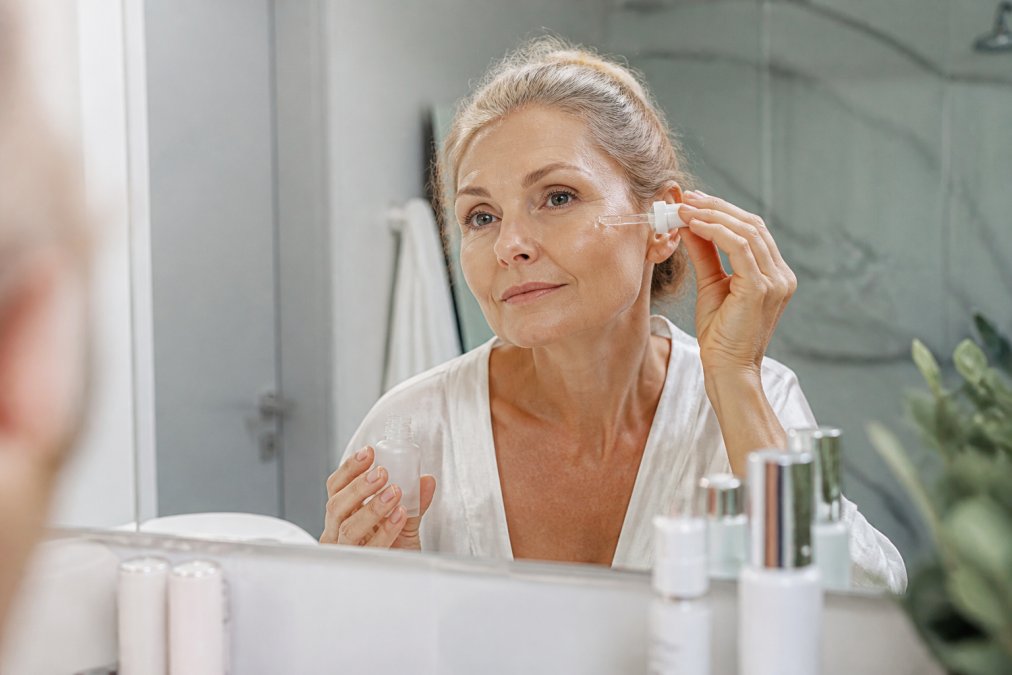
Step 1: Prep With Hydration, Not Powder
Start with a serum, then a moisturizer, then wait two full minutes. This gives the skin time to absorb product so foundation glides instead of dragging. A common mistake is applying primer directly onto dry skin, which creates a tacky surface that grabs pigment unevenly.
Step 2: Apply in Thin Layers With the Right Tools
Use a damp sponge or a dense synthetic brush, and press rather than sweep. Thin layers build coverage gradually and prevent caking. One heavy application is harder to blend than three light ones.
Step 3: Set Only Where You Need It
Set the T-zone and under-eyes with the smallest amount of translucent powder. Leave the cheeks and jawline unpowdered to keep that dewy finish and let natural radiance show through.
Best Concealer for Mature Skin Over 50: What Actually Works
The best concealer for mature skin over 50 is a hydrating, buildable formula with a peach or salmon undertone, applied in a thin triangle rather than a thick half-moon. Thick, matte concealers are the biggest culprit behind creasing under the eyes. But the formula is only half the story. The other half is what is in it, what is not, and what you apply it with.
Ingredients to Look For
- Hydrating base: glycerin, hyaluronic acid, or squalane near the top of the ingredient list
- Buildable coverage: medium pigment you can layer, not full-coverage paste
- Peach or salmon undertone: neutralizes blue-toned dark circles better than pale beige
- Non-comedogenic: matters if you are also prone to congestion
- Peptides or ceramides: support the thin barrier under the eye over time
Ingredients to Avoid on Sensitive Mature Skin
Most guides stop at finish and never mention what can actively irritate thin under-eye skin. A common pattern among people over 50 is reacting to one of these rather than to the pigment itself:
- Denatured alcohol or alcohol denat. high on the list: speeds drying, which is the opposite of what crease-prone skin needs
- Heavy silica or talc as a primary filler: absorbs oil well but pulls moisture from already-dry skin and can look chalky by hour four
- Fragrance and essential oils (citrus, lavender, peppermint): frequent triggers for stinging and redness in the orbital area
- Physical exfoliants in a concealer-adjacent product: never appropriate near the lash line
- Retinol in an under-eye concealer: fine in a dedicated eye cream at night, but it increases flaking under makeup during the day
If your under-eyes sting, water, or turn pink within an hour of application, the culprit is usually one of the above, not the shade match.

Application: The Tool Matters More Than the Formula
A small, dense synthetic brush gives the most control and the least product waste. A damp sponge shears the pigment thinner and is better for very dry skin that cannot tolerate any visible texture. A ring finger works in a pinch but deposits more product than most people realize, which is exactly what causes creasing.
The technique that reduces settling most:
- Tap a pinhead-sized amount at the inner corner.
- Press outward with the brush or sponge, do not sweep.
- Let it sit for 30 seconds before blending the edges.
- Set only the inner corner with the lightest dusting of finely milled powder, or skip powder entirely on very dry skin.
Top Cosmetikly Alternatives That Beat Milk Makeup for Mature Skin
Cosmetikly's lineup targets the exact problems Milk Makeup's sheer, cooling formulas leave unaddressed: barrier hydration, firmness, and long-wear comfort on seasoned skin. Each product below plays a specific role in a mature-skin routine.
Radiant Youth Trio Serums: The Hydration Base
This three-serum set pairs vitamin C, retinol, and hyaluronic acid, the combination that does the most for fine lines and dullness. Vitamin C targets sun damage and uneven tone. Retinol supports collagen and softens crow's feet over time. Hyaluronic acid plumps and holds water in the skin so foundation has a smoother surface to sit on. At $199.99, it is the foundation layer of the whole routine, and it is the step that makes every product applied afterward perform better.
RevitaLift Eye Cream: Firming the Delicate Eye Area
Hyaluronic acid and collagen support make this cream a direct answer to crow's feet and under-eye creasing. Apply a pea-sized amount around the orbital bone and massage gently until absorbed. It costs $62.00 and works best as a nightly step, since the eye area needs consistent hydration to stop concealer from settling.
Anti-Aging Collagen Facial Serum: Daily Firming Support
With CoQ10, argan oil, and collagen, this $60.00 serum is the lightweight daily option for anyone who finds heavier creams too much under makeup. Use it morning and night as the step before moisturizer. It absorbs quickly, which matters when you are layering foundation on top and don't want slip or pilling.
| Product | Price | Primary Job | Best For |
|---|---|---|---|
| Radiant Youth Trio Serums | $199.99 | Fine lines, dullness, hydration | Full anti-aging routine |
| RevitaLift Eye Cream | $62.00 | Firming the eye area | Crow's feet, under-eye creasing |
| Anti-Aging Collagen Facial Serum | $60.00 | Daily firming and moisture | Layering under makeup |
The throughline here is simple: hydration first, coverage second. A serum-and-eye-cream base does more for how foundation wears than any primer.
Explore our premium makeup tools and accessories →
Dewy vs. Matte Finish: Which Lasts Better on Seasoned Skin?
Dewy finish generally lasts better on mature skin than matte, because matte formulas pull moisture from the surface and exaggerate every fine line and wrinkle. That said, "dewy" does not mean greasy, and the distinction matters.
Why Finish Behaves Differently After 40
Two things change. First, sebum production drops, so the skin has less of its own oil to keep pigment flexible and moving with the face instead of cracking along expression lines (pubmed.ncbi.nlm.nih.gov). Second, the moisture barrier thins, so water escapes faster and the surface texture becomes less uniform. A matte formula, which relies on powders to absorb oil and blur shine, has nothing left to absorb on dry mature skin, so it sits on top, looks chalky, and settles into every groove.
A luminous, satin finish reflects light in a way that softens texture and gives a more youthful appearance. A flat matte finish absorbs light and makes skin look drier and older than it is. For most people over 40, a natural finish with a slight glow is the safer bet.
Where Matte Still Wins
Matte is not the enemy. It is the wrong default. It still works for:
- Oily mature skin: if you are still producing noticeable shine by midday, a soft matte keeps it in check
- Humid climates: dewy formulas can slide in high humidity; a satin-matte hybrid holds better
- Long event days: eight-plus hours under warm lighting is where matte's oil control earns its keep
- Photography: matte reads cleaner on camera than high-shine finishes, which can look wet under flash
Even then, choose a matte formula with hydrating ingredients, glycerin, squalane, or a peptide blend, rather than a drying one. The finish should be matte; the formula should not be dehydrating.
The Middle Ground Most People Miss
Satin and natural finishes are the practical answer for most mature skin, and they are under-discussed because they do not fit neatly into the dewy-versus-matte binary. A satin finish reflects light softly without looking wet, holds up longer than full dewy, and does not pull moisture the way matte does. If you are unsure where to start, satin is the safer first test.
How to Prevent Cream Makeup From Settling Into Fine Lines
Settling happens when product migrates into lines that move, especially around the eyes, mouth, and forehead. Prevention is a sequence, not a single trick.
- Hydrate first: moisturized skin holds pigment on the surface instead of letting it sink.
- Use a gripping primer: a tacky, hydrating primer creates a surface that keeps cream foundation in place.
- Apply thin layers: build coverage gradually so no single area carries too much product.
- Press, don't sweep: sweeping pushes product into lines; pressing keeps it on top.
- Set selectively: powder only where you actually shine.
- Blot, don't re-powder: throughout the day, blot oil with a tissue before adding anything.
A common mistake is layering more foundation over settled product to "fix" it. That adds weight and makes the creasing worse. Blot, then touch up with a tiny amount of concealer only where needed.
Budget-Friendly vs. Luxury: Where the Real Difference Shows
The gap between budget and luxury makeup is smaller than the marketing suggests, and it shows up in three specific places: pigment quality, wear time, and ingredient concentration. Everything else is largely packaging and positioning.
Where budget formulas often match luxury: basic coverage, shade range, and everyday wear for short days. Where luxury pulls ahead: finely milled pigments that blend without patchiness, higher concentrations of skin-loving ingredients like hyaluronic acid and peptides, and formulas engineered to stay put for ten or more hours.
For mature skin specifically, the ingredient list matters more than the price tag. A mid-range formula with hyaluronic acid and a non-comedogenic base will usually outperform a luxury matte formula that dries the skin out. Spend your budget where it changes the outcome: serums, eye cream, and a foundation with genuine hydration.
Application tools deserve a mention here too. A damp sponge and a dense brush cost far less than a prestige foundation and often improve the finish more than upgrading the product itself. Tool quality affects blendability and grip, two things that directly reduce settling.
Finding a Milk Makeup alternative for mature skin comes down to one shift: stop chasing weightless coverage and start building a hydrated base. Cosmetikly's Radiant Youth Trio Serums, RevitaLift Eye Cream, and Anti-Aging Collagen Facial Serum give you the firming, hydrating foundation that makes every layer above it behave. Explore Cosmetikly's premium makeup tools and skincare to build a routine that keeps coverage smooth from morning to night, backed by a 30-day trial and free delivery on orders over $99.

Frequently Asked Questions
Is Milk Makeup good for mature skin?
Milk Makeup formulas tend to be lightweight and buildable, which can work for some mature skin types. However, many of their products focus on a matte or blurred finish that can emphasize dryness and settle into fine lines. If your skin is drier or you are looking for firming and hydrating benefits, a milk makeup alternative formulated with collagen, hyaluronic acid, or ceramides will serve you better. Look for products that prioritize hydration and skin-loving ingredients over long-wear matte claims.
What is the best concealer for mature skin over 50?
The best concealer for mature skin over 50 is one with a creamy, hydrating texture that won't crease under the eyes. Avoid heavy matte formulas that dry down quickly. Instead, choose a concealer with ingredients like hyaluronic acid or peptides, and apply it in thin layers with a damp sponge or your ring finger. Setting with a light dusting of finely milled powder only where needed helps prevent settling. Pairing concealer with a firming eye cream, such as Cosmetikly's RevitaLift Eye Cream, creates a smoother base.
How do I prevent cream makeup from settling into fine lines?
Start with hydrated skin: apply a serum and moisturizer, then wait two to three minutes before makeup. Use a gripping primer only on areas prone to creasing, like the nasolabial folds and forehead. Apply foundation in thin layers with a damp beauty sponge, pressing rather than sweeping. Avoid over-powdering; set only the T-zone with a light hand. Products with plumping ingredients like collagen and hyaluronic acid help maintain moisture throughout the day, reducing the chance of makeup settling into fine lines.
Which makeup brands are best for dry, mature skin?
Brands that prioritize hydration, skin-loving ingredients, and dewy finishes tend to perform best for dry, mature skin. Look for formulas with hyaluronic acid, glycerin, collagen, or ceramides. Cosmetikly offers several options, including the Anti-Aging Collagen Facial Serum and Radiant Youth Trio Serums, which can be layered under makeup for a smooth, hydrated base. Avoid brands that focus heavily on matte, long-wear formulas, as these can accentuate dryness and make fine lines more visible.
What is a good dupe for Milk Makeup products for mature skin?
A good milk makeup alternative for mature skin focuses on hydration and firming rather than blurring or mattifying. Cosmetikly's Radiant Youth Trio Serums and Anti-Aging Collagen Facial Serum provide a plumping, luminous base that helps makeup glide on smoothly. For targeted areas, the Smoothing Nasolabial Patches with Collagen and Glycerin temporarily reduce the look of lines, making them a smart prep step before foundation. These options prioritize skin health alongside coverage.