

Milk Makeup vs Professional Brands: 2026 Comparison
Table of Contents
- Milk Makeup vs Professional Brands: The 2026 Comparison Table
- Clean Beauty vs Professional Makeup Performance: What Actually Differs
- Best Cruelty Free Foundation 2026: What to Look For
- Professional Makeup Artist Kit Essentials vs Retail Formulas
- Cost-Per-Use: Why the Cheaper Product Sometimes Costs More
- Bridal, Photography, and Everyday Wear: Matching the Product to the Job
- Skin Sensitivity, Non-Comedogenic Claims, and Ingredient Quality
- Where Each Category Wins: A Decision Framework
- Frequently Asked Questions
Last Updated: September 12, 2026
Milk Makeup vs Professional Brands: The 2026 Comparison Table
Milk Makeup vs professional brands is a question about two different design philosophies, not two quality tiers. Milk Makeup builds consumer-grade, clean-positioned formulas for quick everyday application, while professional brands build professional-grade formulas around pigmentation, formula stability, and long-wear performance under studio or event conditions. At Cosmetikly, we see this split most clearly in kit essentials: retail formulas prioritize texture and finish for daily wear, while professional formulas prioritize color payoff and wear time. The table below summarizes where each category wins.
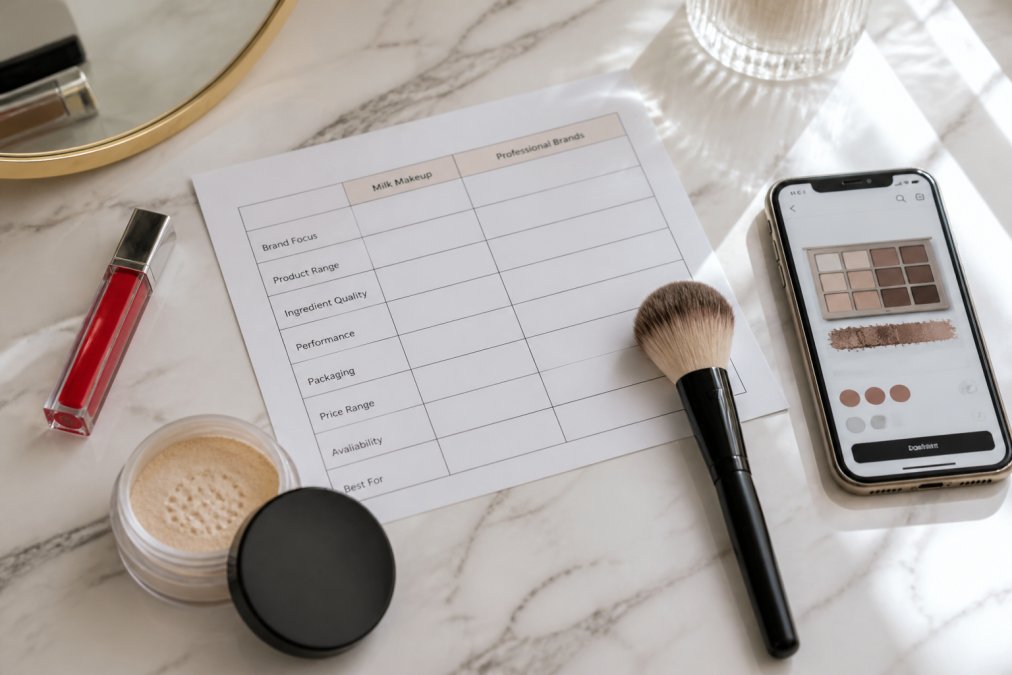
| Factor | Milk Makeup (Consumer/Retail) | Professional-Grade Brands |
|---|---|---|
| Pigmentation | Buildable, sheer to medium | High-coverage, one-swipe color payoff |
| Longevity | Good for 8-hour everyday wear | Built for 12-hour wear and photography |
| Formula focus | Clean beauty, vegan, cruelty-free | Formula stability, blendability, kit essentials |
| Best for | Everyday makeup, quick routines | Bridal makeup, photography-ready looks |
| Price logic | Lower upfront cost | Higher upfront, lower cost-per-use |
Clean Beauty vs Professional Makeup Performance: What Actually Differs
Clean beauty vs professional makeup performance comes down to how each category balances ingredient quality against wear time, and the difference is more chemical than philosophical. Most articles stop at "clean feels lighter, pro lasts longer." The useful version names the ingredient classes doing the work, because that is what determines whether a formula survives a humid afternoon or a flash photograph.

The Ingredient Classes That Decide Performance
Three functional groups drive most of the gap:
- Film-formers and polymers. Professional-grade bases and long-wear lips lean on film-forming polymers that dry down into a flexible, water- and oil-resistant layer. This is the mechanism behind one-swipe coverage that stays put. Clean-positioned retail formulas often reduce or omit these because they can feel tight or require a specific removal routine.
- Silicone and emollient systems. Dimethicone and related silicones give professional formulas their slip, blendability, and resistance to settling into fine lines. Many clean beauty lines swap these for plant oils and waxes, which feel skin-first but break down faster under oil and heat.
- Pigment load and dispersion. High-coverage professional formulas carry a higher pigment-to-binder ratio and use treated pigments that disperse evenly. Retail formulas frequently lower pigment load to keep texture creamy and forgiving, which is why they build in layers rather than covering in one pass.
None of these is inherently "better." A film-former that resists a 12-hour event can also resist your cleanser. A plant-oil base that feels lovely at 9 a.m. may be gone by 2 p.m. The trade-off is real, and it is mechanical, not moral.
Pigmentation, Blendability, and Color Payoff
Pigmentation is the concentration of color in a formula, and it is the clearest functional gap between these two categories. Professional-grade products typically deliver higher pigmentation, so a single pass covers more surface with less product. Consumer-grade formulas often build color in layers, which suits everyday makeup but slows down application technique when you need speed. Blendability tends to favor retail formulas, which are engineered to melt into skin without a steep learning curve, largely because that lower pigment load and higher emollient content give you more working time before the formula sets.
Longevity in Heat, Humidity, and 12-Hour Wear
Long-wear performance is where professional formulas separate themselves most, and it is measurable in a way most reviews ignore. A common pattern in professional-grade lines is a film-former paired with oil-absorbing powders, rice powder, silica, kaolin, that pull sebum away from the pigment layer (PubMed). That combination is why makeup artist kit essentials so often include a mattifying setting powder as the finishing step, not an optional one.
Retail formulas increasingly close this gap, but most still target an 8-hour day rather than a 12-hour event. If your day includes heat, humidity, or a long shoot, plan for touch-ups unless you are using a professional-grade base, and understand that the touch-up itself is the tell. A formula that needs blotting and re-powdering at hour six is doing exactly what it was designed to do.
Best Cruelty Free Foundation 2026: What to Look For
The best cruelty free foundation 2026 is one that pairs a verified cruelty-free certification with a formula built for your actual wear time, not just a clean label. Start with certification, then check pigment load, finish, and whether the formula suits your skin sensitivity. A foundation can be vegan and still perform poorly for bridal or photography work if it breaks down under flash or humidity.
Certifications That Actually Mean Something
Certifications that actually mean something are third-party and verifiable, not self-declared. Look for a recognized cruelty-free program logo on the packaging rather than a marketing phrase like "not tested on animals." Vegan formulas are a separate claim from cruelty-free, and a product can be one without the other. Dermatologist-tested and non-comedogenic claims are also worth checking at the source, since these describe testing method, not a guarantee for every skin type.
Professional Makeup Artist Kit Essentials vs Retail Formulas
Professional makeup artist kit essentials are chosen for repeatability, not novelty. A working kit usually carries a high-coverage base, a mattifying setting powder, a long-wear lip, and tools that hold their shape through repeated sanitizing. Retail formulas are designed for a single user and a shorter shelf life expectation. That is not a knock on retail: a cult-favorite consumer product can outperform a mediocre professional one, and hype-driven launches sometimes beat both on texture and finish. The difference shows up in consistency across a full kit.

For lips specifically, a hydrating gloss serum with a stain effect, like the NYX PROFESSIONAL MAKEUP Lip IV Hydrating Gloss Serum Lip Stain with 12HR Hydration - Cranberry Splash, is the kind of dual-purpose item that earns space in a professional kit because it delivers both instant shine and over-time color. For a softer everyday finish, a buttery gloss such as the NYX Silky Butter Gloss - Creme Brulee gives sheer-to-medium coverage without stickiness, which matters when you are layering over a long-wear base.

Cost-Per-Use: Why the Cheaper Product Sometimes Costs More
Cost-per-use is the price of a product divided by the number of applications you actually get from it. Most reviews stop there and tell you to "consider value." The useful version runs the numbers, because the arithmetic is where the retail-vs-professional decision actually gets settled.
The Formula, and Why Volume Alone Misleads
Cost-per-use = price ÷ number of full-face applications per unit.
The trap is that applications per unit is not the same as ounces per unit. A higher-pigment professional base covers a full face in roughly one pass; a sheerer retail base may need two or three passes to reach the same coverage (PubMed). So a 1 oz professional foundation and a 1 oz retail foundation can deliver very different application counts even at identical volume, the professional bottle often stretches further because you use less per face.
Explore our premium makeup tools and accessories →
A second variable is touch-ups. If a formula fades by midday and you reapply base or powder, each wear day consumes more product than the label implies. Count touch-ups as fractional applications when you run the math.
A Worked Comparison
Say a professional-grade base costs more upfront but yields about 60 full-face applications per unit, while a cheaper retail base yields about 30 because of layering and midday touch-ups. Divide each price by its application count and the professional option's per-wear cost can land at or below the retail option's, despite the higher sticker price. The same logic applies to setting powder, where a finely milled, high-absorbency powder needs a lighter dusting per use than a coarser one.
This is the calculation most reviews skip, and it is the one that decides whether a "cheap" product is genuinely cheaper. It also cuts the other way: a professional product you use twice a year has a terrible cost-per-use no matter how good it is. Frequency is half the equation.
How to Run It on Your Own Kit
- Note the price and the stated volume of each product.
- Track how many full-face applications you get before it runs out, not how long it lasted in weeks.
- Count touch-ups as extra applications.
- Divide price by total applications.
- Compare across categories, not just within one. A base and a setting powder are not interchangeable line items.
Bridal, Photography, and Everyday Wear: Matching the Product to the Job
Bridal makeup and photography-ready looks demand formula stability that everyday makeup does not. Flash photography exposes pigments that shift under light, and a long event day exposes any weakness in wear time (PubMed). Professional-grade formulas are built to hold color and texture through both. Everyday wearability, by contrast, favors lighter textures and skin-first ingredients that feel comfortable for eight hours. The mistake is buying one product for both jobs.
| Job | Priority | Best Category |
|---|---|---|
| Everyday makeup | Comfort, quick application | Consumer/retail formulas |
| Bridal makeup | 12-hour wear, no flashback | Professional-grade |
| Photography | Color accuracy, blendability | Professional-grade |
| Sensitive skin daily wear | Skin-first ingredients | Clean beauty formulas |
Skin Sensitivity, Non-Comedogenic Claims, and Ingredient Quality
Skin sensitivity is the factor that most often flips the recommendation. A high-pigment professional formula is not automatically the right pick if your skin reacts to heavier textures, and a clean beauty formula is not automatically gentle just because it avoids certain ingredients. Non-comedogenic and dermatologist-tested claims describe how a product was assessed, not a personal guarantee. If your skin is prone to congestion, patch-test first and read the full ingredient list rather than trusting a front-of-pack label.
Where Each Category Wins: A Decision Framework
Where each category wins depends on the job, the wear time, and your skin. Use this framework to decide before you spend.
- Choose consumer/retail formulas if your priority is everyday makeup, quick application, and a lighter texture and finish.
- Choose professional-grade formulas if you need high-coverage, 12-hour wear, or photography-ready results.
- Choose clean beauty lines if ingredient quality and cruelty-free, vegan formulas are non-negotiable for you.
- Calculate cost-per-use before ruling out a higher-priced product.
- Patch-test anything new if you have skin sensitivity or congestion concerns.
For setting and finishing, a mattifying powder is the single item that most changes wear time. The Glo Skin Beauty Loose Matte Finishing Powder is a cruelty-free option built around oil-absorbing rice powder, and the NYX PROFESSIONAL MAKEUP Mineral Matte Finishing Powder offers a hint of color that works over makeup or on bare skin.
The real challenge is not picking a side between retail and professional formulas, it is matching each product to the job it was built for. Cosmetikly stocks professional-grade tools and high-performance formulas, including dermatologist-approved skincare and vegan, cruelty-free makeup, so you can build a kit that holds up from everyday wear to event day. Every order over $99 ships free, and our 30-day trial period and 24/7 support team make it easy to test before you commit. Explore our premium makeup tools and accessories and build a routine that performs.
Frequently Asked Questions
Is Milk Makeup considered a professional-grade brand?
Milk Makeup sits in the prestige retail category, not the professional-grade category. Professional lines are built for kit use: higher pigment loads, longer shelf stability, and formulas tested for photography and stage lighting. Milk Makeup targets everyday consumers with clean beauty positioning, vegan formulas, and easy application. That does not make it bad, but it means the two categories solve different problems. If you need 12-hour wear under studio lights or on a bridal client, professional-grade formulas usually hold up better.
How does Milk Makeup compare to professional brands in terms of longevity?
Longevity depends on the formula type and the base underneath it. Professional-grade products typically use higher concentrations of film-formers and pigments, which helps them resist heat, humidity, and oil breakthrough over a full day. Retail clean beauty formulas often prioritize comfort and lightweight feel, which can mean more frequent touch-ups. For a wedding or a long shoot, layer a mattifying setting powder over your base to extend wear regardless of which brand you use.
Is Milk Makeup cruelty-free and vegan, and do professional brands match that?
Milk Makeup is cruelty-free and mostly vegan, which is a real advantage if ethical sourcing matters to you. Professional brands vary widely: some carry cruelty-free certification, others sell in markets that require animal testing. When shopping the best cruelty free foundation 2026, check for third-party certification rather than a brand's own claim. Leaping Bunny and PETA's Beauty Without Bunnies are the two programs that verify a supply chain, not just a finished product.
What should I keep in a professional makeup artist kit essentials list?
A working kit needs more than foundation. Build around a mattifying loose setting powder for oil control, a long-wear hydrating lip stain for touch-ups between clients, a plumping gloss for photography shine, and at least two finishing powders in different tones. Add disposable applicators, mixing palettes, and alcohol wipes. The goal is products that perform across skin types and hold up under camera, not a collection of trend items. Test everything on yourself before it goes in the kit.
Why does cost-per-use matter more than the sticker price?
A $65 lip stain that lasts 12 hours and survives meals can cost less per wear than a $20 gloss you reapply six times a day. Divide the price by the number of uses you actually get. Professional-grade products often win this math because they need less product per application and fewer touch-ups. Retail formulas win when you use them lightly and finish them before they expire. Track how long a product actually lasts you before deciding which category is cheaper.