

Benefits of Using High Quality Makeup Brushes
Table of Contents
- Why High Quality Makeup Brushes Change Your Routine
- The Real Difference Between Cheap and High Quality Brushes
- Makeup Brush Types and Uses: A Complete Face and Eye Guide
- Precise Application and Even Coverage: What Better Bristles Deliver
- How to Choose Makeup Brushes for Your Skin and Routine
- Makeup Brush vs Makeup Sponge: Which Tool Wins for Your Look
- How to Clean Makeup Brushes and Make Them Last
- Cost Per Use, Materials, and Long-Term Value
- Conclusion: Better Brushes, Better Results
- Frequently Asked Questions
Last Updated: October 4, 2026
Why High Quality Makeup Brushes Change Your Routine
The benefits of using high quality makeup brushes come down to one thing: control. A good brush puts product exactly where you want it, in the amount you want, without tugging at your skin.

Cheap brushes shed, scratch, and soak up half your foundation before it reaches your face.
Keep reading to learn how to match brush types to your routine, clean them, and judge whether a set is worth the price.
The Real Difference Between Cheap and High Quality Brushes
What matters is bristle material, density, and how the ferrule (the metal band) is attached.
Here's what separates the two:
- Bristles: low-cost brushes use coarse, loosely packed fibers that absorb product and shed. Quality synthetic bristles are fine, densely packed, and cut to a consistent shape.
- Construction: cheap ferrules loosen and handles crack; better brushes use sealed ferrules and solid handles that survive washing.
- Softness: rough bristles drag across the eyelid and irritate sensitive skin, while soft bristles glide.
For liquid and cream products, synthetic bristles don't absorb moisture, and they're vegan and cruelty-free, which is why every brush in our collection uses synthetic fiber.
Makeup Brush Types and Uses: A Complete Face and Eye Guide
A complete kit covers two zones: face and eyes. Head geometry, fiber density, and cut determine how product moves from bristle to skin.
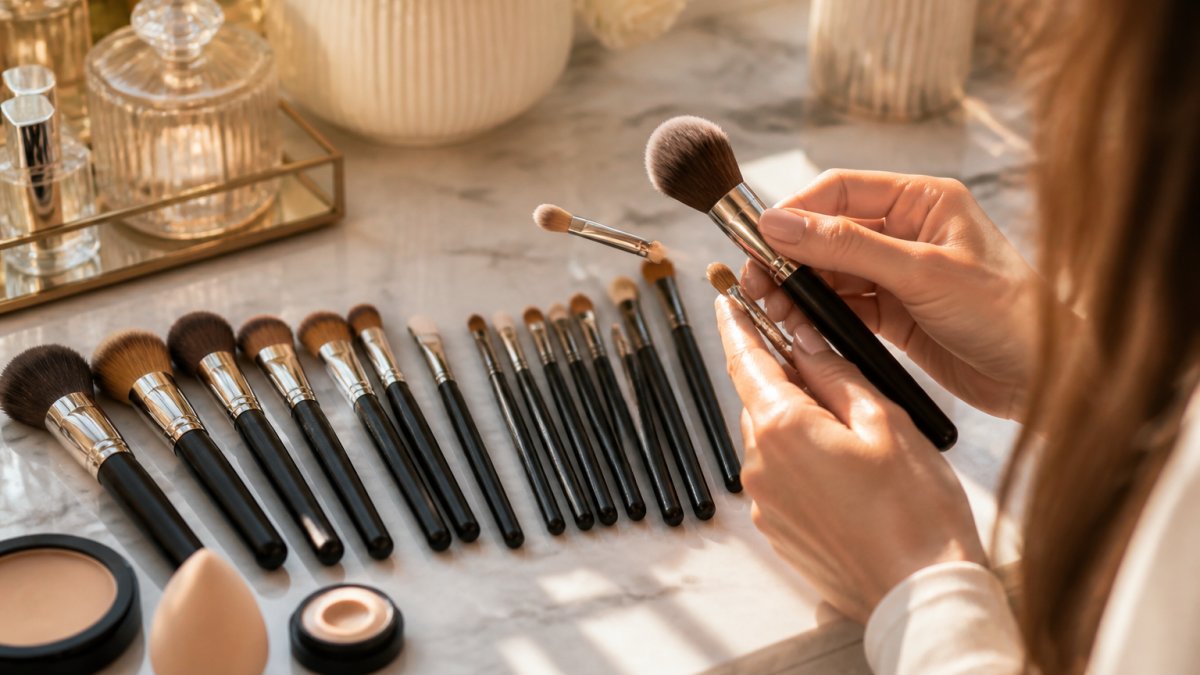
Face Brushes: Foundation, Concealer, Powder, Blush, and Contour
Foundation brushes are flat, dense, and slightly domed or angled.
Concealer brushes are smaller and firmer, often with a tapered or flat paddle head.
Powder brushes are large and fluffy with plenty of loft, picking up a light, even layer of setting powder.
Blush brushes are angled or domed to place color without harsh edges.
Contour brushes are firmer and more tapered, building shadow along the cheekbones and jawline with control.
Eye Brushes: Packing, Blending, Crease, Smudging, and Brow
Packing brushes are flat and firm, pressing eyeshadow onto the lid for maximum payoff. Pressing, not sweeping, makes pigment stick.
Blending brushes are soft and rounded, softening harsh crease lines so shadow looks seamless.
Crease brushes are tapered and slightly firmer than a blender, building depth in the crease without spilling onto the brow bone.
Smudging brushes are small, dense, and often pencil-shaped, softening eyeliner along the lash line.
Matching Brush Shape to Product Format
The shape only works if it matches the product. A quick rule set:
- Liquid and cream products (foundation, concealer, cream blush, cream contour): synthetic bristles, dense heads, flat or buffing shapes.
- Powder products (setting powder, blush, bronzer, eyeshadow): fluffier heads with more loft, natural or synthetic fiber both work.
- Cream-to-powder and stick formulas: firm synthetic heads that can pick up the product without dragging.
If you'd rather not build a kit brush by brush, a complete set solves this in one purchase. Our Set of 15 Professional Synthetic Makeup Brushes covers powder foundation, contour, blush, concealer, crease blending, brow, liner, and lip, with vegan synthetic bristles that won't shed.
Precise Application and Even Coverage: What Better Bristles Deliver
Precise application starts with bristle density. A densely packed brush holds product evenly, so the first pass and last pass deposit the same amount of color.
That difference shows up most in three places:
- Foundation: dense bristles buff product into the skin for a streak-free finish instead of sitting on top of it.
- Eyeshadow: a firm packing brush builds color payoff quickly, while a soft blending brush melts the edges into a gradient.
- Blush and bronzer: a full, domed head distributes powder evenly so you avoid the dreaded stripe across the cheek.
Soft bristles also protect your skin barrier. Gentle tools let you blend longer without irritation.
How to Choose Makeup Brushes for Your Skin and Routine
Choosing makeup brushes comes down to three questions: what products you use, how much time you have, and how sensitive your skin is. If you wear mostly liquid foundation and cream blush, prioritize synthetic bristles and dense shapes; if you prefer powder, look for fluffier heads with plenty of loft.
Set of 15 Professional Synthetic Makeup Brushes →
Then match the kit to your routine:
- Ten-minute mornings: a small set of four or five multi-use brushes beats a 20-piece kit you never open.
- Full glam: you'll want dedicated packing, blending, and definer brushes for the eyes.
- Sensitive or breakout-prone skin: soft synthetic bristles plus a regular cleaning schedule matter more than brush count.
For a starter kit that covers both face and eyes without overwhelming a small vanity, our 12-Piece Makeup Brush Set and Beauty Tools uses soft, durable fiber suitable for all skin types. If you want maximum versatility in one tool, the Synthetic All-in-1 Oval Brush blends foundation, powder, cream, moisturizer, and primer with a pointed tip for under the eye.


Makeup Brush vs Makeup Sponge: Which Tool Wins for Your Look
The makeup brush vs makeup sponge debate has a simple answer: brushes offer coverage and control, while sponges offer speed and a sheer, damp finish.
Sponges press product in with a bouncing motion, popular for a light, natural look, but they soak up noticeable amounts of liquid foundation.
Many people use both, a brush for foundation coverage, then a sponge to soften edges.
| Tool | Best For | Product Waste | Lifespan |
|---|---|---|---|
| Foundation brush | Full coverage, precise placement | Low | Years with washing |
| Blending brush | Eyeshadow gradients, soft edges | Low | Years with washing |
| Kabuki brush | Powder, bronzer, body glow | Low | Years with washing |
| Makeup sponge | Sheer, damp finish, quick blending | Higher | Weeks to months |
How to Clean Makeup Brushes and Make Them Last
Cleaning makeup brushes should happen every one to two weeks for face brushes, and more often if you're breakout-prone. Dirty bristles can transfer oil, dead skin, and bacteria back onto your face.
Here's the method we recommend:
- Rinse the bristles under warm water, pointing downward so water doesn't run into the ferrule.
- Add a small amount of brush cleaner or gentle soap to a glass or your palm.
- Swirl the bristle tips gently, working the lather through the fibers.
- Rinse until the water runs clear, keeping the handle dry.
- Press the bristles gently into a soft cloth to reshape the tip.
- Lay the brush flat to air-dry with the head slightly lower than the handle.
Never stand a wet brush upright to dry. Water seeps into the ferrule, breaks down the glue, and causes shedding. Never dry brushes on a radiator or with a hairdryer either, since heat warps synthetic fibers.
Cost Per Use, Materials, and Long-Term Value
Cost per use is the number that actually matters. A cheap brush replaced every few months costs more over a year than one well-made brush that lasts several years. The reason is construction: materials determine how long a brush survives washing, and washing is what kills brushes.
Running the Math on Your Own Kit
Cost per use is simple: divide the price by the number of uses you expect before the brush fails.
A well-made synthetic brush used four times a week and washed every two weeks can last two to three years before bristles splay or the ferrule loosens.
People commonly replace cheap brushes two to four times in the period a single quality brush lasts.
The Materials That Drive Durability
Four components determine whether a brush survives years of washing or fails in months:
- Bristle fiber. Synthetic bristles (polyester, nylon, or a blend) are standard for liquid and cream products because they don't absorb moisture like animal hair. They hold a cut shape better after repeated washing and are vegan and cruelty-free.
- Bristle density and cut. Densely packed fibers hold their shape and distribute product evenly; sparse fibers splay and dump product in one spot. A consistent cut keeps the brush working the same way after the tenth wash as on the first.
- Ferrule construction. The ferrule is the metal band joining bristles to handle. Cheap ones are crimped loosely and glued with weak adhesive, so water seeps in and the glue breaks down. Better brushes use a sealed ferrule that keeps water out of the glue line, the single most common failure point on any brush.
What to Look For Before You Buy
You can assess most of this in the package or in your hand:
- Synthetic bristles for liquid and cream products, plus vegan and cruelty-free credentials if that matters to you.
- Densely packed fibers that spring back when pressed against your palm instead of staying flattened.
- A ferrule that does not wiggle when you gently twist the head. If it moves in the store, it will move more after washing.
- A solid handle with a comfortable grip and a sealed finish.
Building a kit around materials rather than price tags means buying tools once instead of repeatedly. Our Synthetic Kabuki Brush is a good example: an oversized head of soft synthetic bristles for powder, bronzer, and highlighter that holds up to regular washing.
Conclusion: Better Brushes, Better Results
If your foundation looks patchy, your eyeshadow won't blend, or your skin reacts after application, examine the brush first.
Cosmetikly builds professional-grade, vegan, and cruelty-free brush sets with soft synthetic bristles designed for sensitive skin, from the 15-piece professional set to single multi-use brushes.
Explore our premium makeup tools and accessories and see the difference a well-made brush makes in your morning.
Frequently Asked Questions
Do high quality makeup brushes really make a difference?
Yes. High quality makeup brushes use densely packed, soft bristles that pick up and distribute product evenly, so foundation and eyeshadow go on smoother with less streaking. They also shed less and hold their shape longer. A set like the Set of 15 Professional Synthetic Makeup Brushes ($187.99) covers eyes, lips, and face with vegan synthetic bristles that are gentle on skin and designed not to shed.
Is a foundation brush or sponge better for mature skin?
A foundation brush can offer control and a smoother, more even finish on mature skin because the bristles buff product into fine lines instead of pressing it in like a sponge. The Synthetic All-in-1 Oval Brush ($42.99) has densely packed fibers for a streak-free finish and a pointed tip that fits under the eye. Sponges work well for quick touch-ups, but brushes can be more efficient with product.
How can you tell if a makeup brush is high quality?
Check three things: bristle softness, density, and how well the brush holds its shape after washing. High quality brushes like the Ultra-Soft Makeup Brush Set for Eyes and Face ($43.00) use soft man-made fibers that feel gentle on skin, resist shedding, and keep their shape over time. Handles should feel balanced and comfortable to grip, and the ferrule should be tightly secured with no wobble.
How often should you clean makeup brushes?
Clean foundation and concealer brushes at least once a week, and eyeshadow or blush brushes every one to two weeks. For a quick clean, rinse the bristles in warm water, swirl the tip in brush cleaner, press gently on a soft cloth to reshape, and air-dry. The Foundation Makeup Brush ($42.00) is designed for easy cleaning with synthetic hair that stands up to regular washing without losing softness.