

Powder Brush vs Liquid Foundation Brush: 2026 Comparison
Table of Contents
- Powder Brush vs Liquid Foundation Brush: The Quick Comparison
- Synthetic vs Natural Hair Makeup Brushes: What Changes in Practice
- Brush Shapes and Density: Matching the Tool to Powder or Liquid
- How to Apply Liquid Foundation Without Streaks
- How to Clean Makeup Brushes So They Keep Their Shape
- Brushes That Cover Both Sides of the Comparison
- Common Mistakes When Choosing and Using a Foundation Brush
- Frequently Asked Questions
Last Updated: September 23, 2026
Powder Brush vs Liquid Foundation Brush: The Quick Comparison
The powder brush vs liquid foundation brush debate comes down to one thing: what your formula needs to look like on skin. A powder brush is a fluffy, loosely packed tool built to dust and diffuse dry product. A liquid foundation brush is denser and often flat-topped, built to press and buff cream or liquid into the skin. Pick the wrong one and you get patchiness, streaks, or a face that looks like it's wearing a mask.

This guide from Cosmetikly breaks down the real differences, the fiber science behind them, and how to stop wasting product.
Here's the short version before we get technical:
| Factor | Powder Brush | Liquid Foundation Brush |
|---|---|---|
| Bristle type | Fluffy, loosely packed | Dense, tightly packed |
| Best formula | Loose or pressed powder | Liquid, cream, BB cream |
| Application motion | Sweeping, dusting | Stippling, buffing |
| Finish | Sheer, diffused | Full to medium, seamless |
| Cleaning frequency | Weekly | After every 1-2 uses |
The 5 sections below cover fiber choice, shape, technique, and the maintenance routine that keeps both brushes working.
Synthetic vs Natural Hair Makeup Brushes: What Changes in Practice
The rule everyone repeats is "synthetic for liquid, natural for powder." That rule is correct, but it's also incomplete.
Here's the practical translation:
- Liquid, cream, BB cream, cream-to-powder: synthetic, non-porous, ideally coated. Higher product payoff, less waste, streak-free transfer.
- Loose powder, pressed powder, blush, bronzer: natural hair or a soft synthetic. The cuticle or a textured synthetic surface grabs and diffuses pigment.
- Cream blush or cream bronzer: synthetic. Natural hair will absorb the emollients.
A quick at-a-glance test you can run in the store: press the bristles against the back of your hand. Natural hair feels slightly rougher and holds a visible dusting of powder; coated synthetic feels slick and releases powder in a clean puff. That tactile difference is the cuticle and the coating doing their jobs.
Brush Shapes and Density: Matching the Tool to Powder or Liquid
Shape and density decide how a brush performs more than the label on the package. A fluffy dome brush and a dense flat-top brush can both be called "foundation brushes," but they do opposite jobs. Density is also the single biggest driver of how much foundation you waste, and that's the part most guides never quantify.
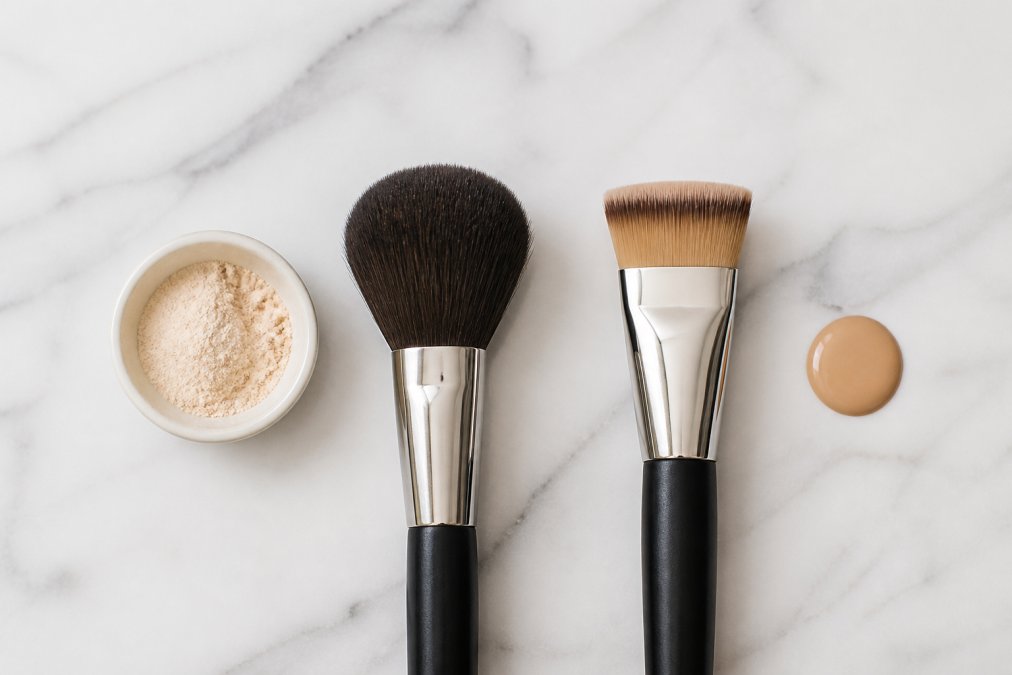
- Fluffy brush with a dome or tapered shape: Loosely packed, airy. Best for powder, bronzer, and a sheer, diffused finish.
- Dense flat-top or kabuki brush: Tightly packed, short bristles. Best for buffing liquid and cream into the skin for full coverage.
- Angled brush: Good for precision application around the nose, under the eyes, and along the jawline.
- Density check: Press the bristles with your thumb. If they splay easily, it's a powder brush. If they spring back firmly, it's built for liquid.
Why density controls product waste
A brush's density is really a measure of how much empty space sits between the bristles. Loose bristles leave wide gaps, and liquid foundation flows into those gaps and stays there, absorbed into the brush head rather than delivered to your face. Dense bristles leave almost no gap, so the product rides on the surface and transfers on contact.

The density spectrum, in practice
- Low density (fluffy): maximum diffusion, minimum coverage, highest liquid absorption. Powder only.
- Medium density (rounded synthetic): balanced, good for sheer-to-medium liquid and for cream products.
- High density (flat-top, kabuki, buffing): maximum coverage and minimum waste with liquid and cream. Can apply powder too heavily if you're not careful.
How to check density without guessing
- Fan test: Hold the brush up to light. If you can see through the head, it's low density.
- Thumb test: Press the center. Splay = low density; firm spring-back = high density.
- Weight test: A dense brush feels heavier in the head relative to the handle.
- Bristle length: Short bristles packed tightly read as denser than long, loose ones, even at similar head size.
Bristle density also controls product absorption. A dense brush picks up and releases more liquid per pass, which is why it covers faster. A loose brush releases powder gradually, which is why it never looks heavy.
How to Apply Liquid Foundation Without Streaks
Streaks come from three things: too much product, the wrong motion, and a brush that's absorbing your foundation. Fix all three and the finish evens out.
Follow these steps:
- Start with a small amount. Dot foundation on your forehead, cheeks, and chin. You can always add more.
- Stipple first, then buff. Press the brush into the skin in short tapping motions to distribute product, then switch to small circles to blend.
- Work in sections. Do one cheek, then the other, then the forehead and chin. Don't drag wet product across dry areas.
- Use the right fiber. A synthetic, non-porous brush keeps the foundation on the surface for even transfer.
- Finish the edges. Blend along the jawline and hairline with light, sweeping strokes to avoid a visible line.
How to Clean Makeup Brushes So They Keep Their Shape
Dirty brushes cause breakouts, apply unevenly, and lose their shape faster. If you have acne-prone or sensitive skin, cleaning is not optional. It's the single biggest hygiene factor in your routine.
A practical wash frequency:
- Liquid foundation brushes: after every one to two uses
- Powder brushes: once a week
- Brushes used on blemishes or around the eyes: after every use
- Rinse the bristles in warm water, pointing downward so water doesn't run into the ferrule.
- Pour brush cleaner into a small glass and dip just the tip.
- Swirl gently, keeping liquid off the handle.
- Press the bristles softly onto a tissue or cloth to reshape the tip.
- Air-dry flat or bristles-down. Never stand a wet brush upright.
Brushes That Cover Both Sides of the Comparison
Some brushes genuinely handle both powder and liquid, which is useful if you're building a small kit. The catch is that "dual-use" brushes are a compromise, not a perfect match for either formula.
Common Mistakes When Choosing and Using a Foundation Brush
Most brush problems trace back to a handful of avoidable errors. Here are the ones I see most often:
- Buying a fluffy brush for liquid foundation. The loose bristles absorb product and leave streaks. Use a dense synthetic brush instead.
- Using natural hair with cream or liquid. The porous fibers soak up the formula and waste it. Save natural hair for powder.
- Skipping the density check. Press the bristles before buying. If they splay, it's a powder brush no matter what the label says.
- Applying too much product at once. Build in thin layers. More foundation never means better coverage, it means caking.
- Ignoring wash frequency. Dirty bristles cause congestion and uneven application, especially on acne-prone skin.
- Storing brushes upright while wet. Water reaches the glue and shortens the brush's life.
Frequently Asked Questions
Can I use a powder brush for liquid foundation?
You can, but the result depends on the bristles. A fluffy powder brush with loosely packed fibers tends to soak up liquid and spread it unevenly, which leaves streaks and wastes product. A dense foundation brush with synthetic bristles holds liquid on the surface instead of absorbing it, so the formula goes onto your face rather than into the brush. If you only own one tool, pick a dense synthetic brush and use a light stippling motion for liquids and a sweeping motion for powders.
Can I use the same brush for foundation and powder?
You can if you clean it between steps, but most people get better results with two. Liquid and cream formulas leave residue that makes a powder brush grab and clump setting powder. If you want one brush to do both, the Foundation Makeup Brush at Cosmetikly is listed as suitable for both liquid and powder foundations. Wipe it on a tissue after the liquid step, then dip into powder. Wash it at least once a week when it touches both formulas.
What type of brush is best for applying foundation?
For liquid and cream formulas, a dense brush with synthetic bristles and a flat-top or rounded dome shape gives the most even coverage. For powder foundation, a fluffy brush with loosely packed bristles and a domed or tapered shape picks up powder evenly and blends it without patchiness. The deciding factor is bristle density, not brand: dense for wet formulas, fluffy for dry ones. Match the brush to the formula you use most, then add the second type later.
What is the best brush to apply liquid foundation for mature skin?
Mature skin usually has more texture and dryness, so a dense brush with soft, flexible synthetic bristles works better than a stiff one. Use a stippling motion, pressing the brush into the skin rather than dragging it, because dragging emphasizes fine lines. The Fat Foundation Brush at Cosmetikly uses nylon bristles and a short handle that gives control for this pressing motion. Apply thin layers and build coverage only where you need it, since heavy layers settle into lines.
How do I tell if a makeup brush is for cream or powder products?
Look at the bristles and the density. Synthetic bristles, which feel smooth and springy, are the standard for cream and liquid formulas because they do not absorb moisture. Natural hair bristles, which feel softer and slightly rougher, work best with powders because the cuticle grabs and releases dry pigment. Density matters too: a dense brush holds wet product on the surface, while a fluffy brush lets powder move through the fibers. When in doubt, check the product listing.