

Skincare Routine for Glowing Skin Over 40
Table of Contents
- What You'll Need Before You Start
- The Best Skincare Ingredients for Mature Skin
- Benefits of Retinol for Women Over 40
- How to Layer Skincare Products Correctly
- How Hormonal Changes in Your 40s Affect Skin
- Morning vs. Evening Routine for Glowing Skin Over 40
- Common Mistakes That Keep Skin Dull
- Frequently Asked Questions
Last Updated: September 22, 2026
What You'll Need Before You Start
A good skincare routine for glowing skin over 40 starts with four basics: a gentle cleanser, a vitamin C serum, a retinol product, and a broad-spectrum sunscreen.
- A gentle, non-foaming cleanser
- A vitamin C or antioxidant serum
- A retinol product (start low and slow)
- A ceramide or peptide moisturizer
- A broad-spectrum sunscreen, SPF 30 or higher
- An eye cream for crow's feet and puffiness
The Best Skincare Ingredients for Mature Skin
The best skincare ingredients for mature skin are ones that support collagen production, hold in hydration, and protect against sun damage. Look for antioxidants, ceramides, and peptides first.

Antioxidants, Ceramides, and Peptides
These three do different jobs, and you want all of them.
| Ingredient | Main Job | Best Time to Use |
|---|---|---|
| Antioxidants | Fight free radicals, brighten | Morning |
| Ceramides | Repair moisture barrier | Morning and night |
| Peptides | Support collagen and firmness | Night |
| Retinol | Speed cell turnover | Night |
| Hyaluronic acid | Draw in hydration | Either |
Benefits of Retinol for Women Over 40
Retinol is the most studied over-the-counter ingredient for fine lines, texture, and dark spots. It speeds up cell turnover, so fresh skin reaches the surface faster, which matters more over 40, when turnover slows and dullness builds up. It also supports collagen production, helping firmness and softening crow's feet.
How to Start Retinol Without Irritation
Follow this ramp-up schedule:
- Week 1: Apply a pea-sized amount twice a week at night.
- Week 2 to 3: Move to every other night if there's no irritation.
- Week 4 and beyond: Use nightly if your skin tolerates it.
- Always apply to dry skin, then follow with moisturizer.
- Skip retinol on nights you use strong exfoliants.
A common mistake is starting nightly right away. That's the fastest route to a raw, peeling face and a product you'll never touch again.
How to Layer Skincare Products Correctly
Layering order matters because thin products can't get through thick ones. Apply from lightest to heaviest, letting each layer dry about 30 seconds.
Here's the correct order:
- Cleanser
- Toner (if you use one)
- Water-based serum (antioxidants, hyaluronic acid)
- Treatment (retinol at night)
- Eye cream
- Moisturizer
- Sunscreen (morning only)
How Hormonal Changes in Your 40s Affect Skin
Hormonal shifts in your 40s change how skin behaves at a structural level. Estrogen, progesterone, and testosterone influence sebum production, barrier repair, pigmentation, and collagen synthesis, and when they fluctuate, skin responds in ways no topical product can fully override.
What Actually Happens to Skin in Perimenopause
Perimenopause, the transition years before menopause, can begin in the late 30s or early 40s and last four to ten years. Estrogen doesn't decline in a straight line, it spikes and drops unpredictably, which is why skin can feel oily one week and papery the next.
Here's what's happening beneath the surface:
- Collagen loss accelerates. Estrogen supports fibroblast activity, the cells that produce collagen and elastin. As estrogen fluctuates downward, collagen production drops. Many dermatologists note that women can lose roughly 30% of skin collagen in the first five years after menopause, and about 2% per year for the next two decades.
- Sebum production falls. Less estrogen means less oil. Skin that was combination or oily at 35 often turns dry or dehydrated by 45.
- The barrier weakens. Estrogen also supports the lipid barrier. A weaker barrier means more transepidermal water loss, more reactivity, and slower recovery from irritation.
- Melasma and pigmentation flare. Hormonal fluctuation can trigger or worsen melasma, especially on the cheeks, upper lip, and forehead. This is the same mechanism behind pregnancy melasma.
- Skin thins. Reduced estrogen is linked to a thinner epidermis and dermis, which makes veins, bruises, and fine lines more visible.
Why Your Old Routine Stopped Working
A 10% retinol that felt fine at 38 can sting at 45. A compromised barrier lets actives penetrate faster and deeper, raising irritation risk, while slower cell turnover means results take longer. The fix isn't to abandon actives, it's to change how you introduce and buffer them.
How to Adjust Your Routine by Phase
Early perimenopause (irregular cycles, occasional dryness):
- Keep your existing actives but add a ceramide moisturizer underneath your retinol.
- Introduce a barrier serum with niacinamide or panthenol.
- Watch for new pigmentation and add a vitamin C or azelaic acid product in the morning.
Mid perimenopause (hot flashes, sleep disruption, persistent dryness):
- Drop foaming cleansers entirely. Use a cream or milk cleanser.
- Reduce retinol to two or three nights per week and buffer with moisturizer.
- Add a hyaluronic acid serum on damp skin before moisturizer.
- Consider a peptide serum to support collagen signaling.
Post-menopause (cycles stopped 12+ months):
- Prioritize barrier repair over exfoliation. Once or twice weekly is usually enough.
- Use a richer night cream with ceramides, squalane, or shea butter.
- Keep daily SPF, since thinner skin burns and marks more easily.
- Ask a dermatologist about prescription options like tretinoin or estrogen creams, which some clinicians prescribe for skin.
What to Do When Skin Turns Reactive Overnight
Sudden sensitivity is one of the most common complaints in this decade. The instinct is to add more products; the better move is to subtract. Strip your routine to three steps, gentle cleanser, ceramide moisturizer, and sunscreen, for two weeks, then reintroduce one product at a time with at least seven days between additions. That's the only reliable way to identify the trigger.
Morning vs. Evening Routine for Glowing Skin Over 40
Your morning routine protects, and your evening routine repairs. Splitting the two is how you get a real glow instead of just clean skin.
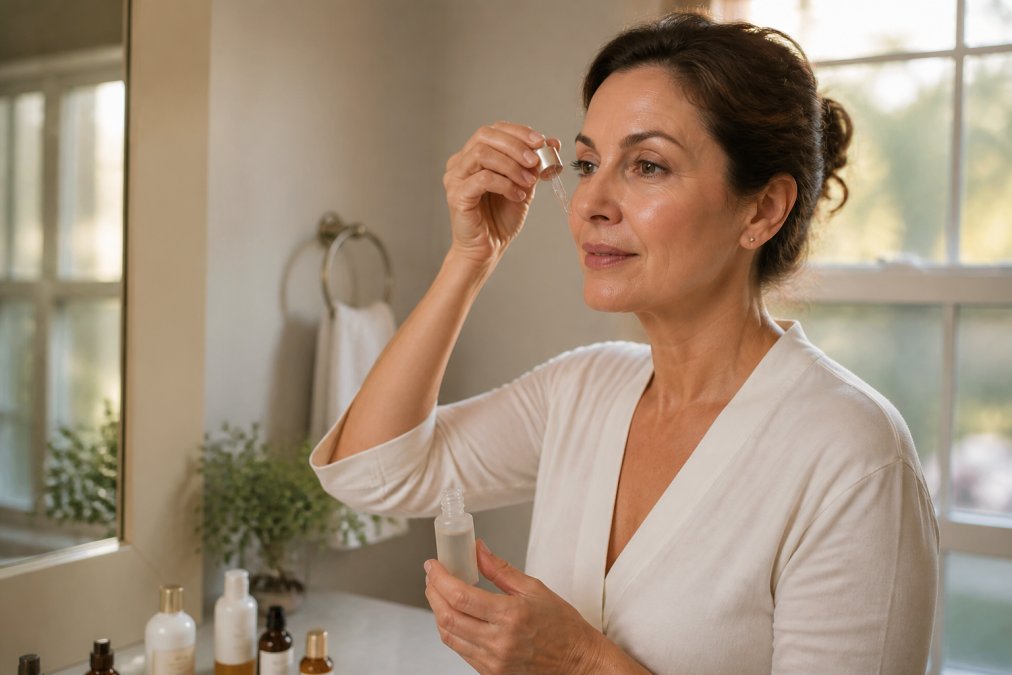
Your Morning Routine
Morning is about defense. Keep it short and consistent.
- Rinse with a gentle cleanser or just water.
- Apply an antioxidant serum, like vitamin C.
- Smooth on a light moisturizer.
- Finish with broad-spectrum sunscreen, SPF 30 or higher.
- Add eye cream if puffiness bothers you.
Sunscreen is non-negotiable. It's the best anti-aging step you can take, and it protects every gain the rest of your routine makes.
Your Evening Routine
Evening is about repair. This is when actives do their work.
- Remove makeup and cleanse gently.
- Apply a water-based serum, like hyaluronic acid.
- Use retinol on the nights your skin allows.
- Dab on eye cream around the orbital bone.
- Seal it all in with a ceramide or peptide night cream.
Common Mistakes That Keep Skin Dull
Most dull skin isn't a product problem, it's a habit problem. Here's how to build a routine that works at three budget levels, plus the mistakes that sabotage all of them.
The Mistakes That Matter Most
- Over-exfoliating. Daily scrubs strip the barrier and cause redness. Two or three times a week is plenty for most 40+ skin. If you use retinol, count that as exfoliation.
- Skipping sunscreen on cloudy days. UV passes through clouds, and it drives most visible aging. A pea-sized amount for the face and neck, reapplied every two hours outdoors, is the standard.
- Using too many actives at once. Retinol, AHAs, BHAs, and vitamin C together irritate most skin. Introduce one new active every two to three weeks.
- Ignoring the neck, chest, and hands. These areas age fast and get none of your routine. Extend your serum and sunscreen down to your collarbones.
- Stopping a product after two weeks. Retinol and vitamin C need eight to twelve weeks to show visible results. Cell turnover in your 40s is slower, so patience matters more than at 25.
- Never moisturizing oily skin. Dehydrated skin can still be oily, and it looks dull either way. Gel-creams work well for this skin type.
- Applying products to dry skin when they need damp skin. Hyaluronic acid needs water to work. Apply it to damp skin, then seal with moisturizer.
Budget-Friendly Routine (Under $60 Total)
You don't need luxury pricing, the active ingredients that matter most are available at drugstore prices.
- Cleanser: A gentle, fragrance-free cream or gel cleanser. CeraVe Hydrating Facial Cleanser and Vanicream Gentle Facial Cleanser are widely recommended by dermatologists.
- Antioxidant: The Ordinary Vitamin C Suspension 23% or a basic L-ascorbic acid serum. Vitamin C is unstable, so buy small bottles and store them away from light.
- Retinol: Differin Gel (adapalene 0.1%) is available over the counter and is one of the most studied retinoids. Start twice weekly.
- Moisturizer: CeraVe Moisturizing Cream or Vanicream Daily Facial Moisturizer, both with ceramides.
- Sunscreen: A broad-spectrum SPF 30+ from a drugstore brand. Look for zinc oxide or avobenzone as the active filter.
Mid-Range Routine ($60 to $200 Total)
This tier buys better textures, more stable formulations, and more elegant sunscreens.
- Cleanser: A cream cleanser from a dermatologist-founded brand.
- Antioxidant: A stabilized vitamin C serum with ferulic acid, which improves stability and penetration.
- Retinol: A encapsulated retinol serum, which releases more slowly and reduces irritation.
- Moisturizer: A peptide or ceramide cream with niacinamide.
- Sunscreen: A tinted mineral or hybrid sunscreen that layers well under makeup.
Clinical and Luxury Routine ($200+ Total)
At this tier, you're paying for formulation science, delivery systems, and sometimes prescription-strength actives.
- Prescription tretinoin (if a dermatologist prescribes it) outperforms any over-the-counter retinol for fine lines and texture.
- Growth factor serums and medical-grade vitamin C with higher concentrations and better stabilization.
- Professional treatments like chemical peels, microneedling, or laser resurfacing, which can cost several hundred dollars per session and require downtime.
The Mistake That Cuts Across Every Budget
Adding products faster than your skin can adjust. Whether you use a $12 drugstore retinol or a $200 clinical serum, the ramp-up is the same: twice weekly for two weeks, then every other night, then nightly if tolerated. Skipping this step is the fastest route to a raw, peeling face. If your skin is sensitive, cut back to cleanser, moisturizer, and sunscreen for two weeks, then add one product back at a time, the only way to know which product caused a reaction.
Frequently Asked Questions
How do I get glowing skin in my 40s?
Focus on four things: collagen production, hydration, cell turnover, and sun protection. A vitamin C antioxidant serum in the morning and a retinol night cream in the evening address the first three. Add a gentle cleanser and a moisturizer with ceramides to support your lipid barrier. Daily sunscreen with SPF 30 or higher prevents further sun damage, which is the main driver of dullness and dark spots after 40. Consistency matters more than the number of products you use.
What are the best skincare ingredients for mature skin?
The strongest evidence supports retinol for cell turnover and collagen production, vitamin C for radiance and pigmentation, hyaluronic acid for hydration, and ceramides for moisture barrier support. Peptides help with skin firmness. Niacinamide reduces redness and evens skin texture. You do not need all of them at once. Start with vitamin C in the morning and retinol at night, then add hydrating ingredients like hyaluronic acid and ceramides as your skin adjusts.
How often should you exfoliate in your 40s?
Two to three times per week is enough for most women over 40. Cell turnover slows with age, so gentle exfoliation helps remove dead skin cells and restores radiance. Choose a chemical exfoliant with lactic acid or glycolic acid over a harsh scrub. If you use retinol, alternate nights so you are not exfoliating and using retinol on the same evening. Over-exfoliating weakens the moisture barrier and causes sensitivity, redness, and more visible fine lines.
Can I use retinol and vitamin C together?
Yes, but at different times of day. Use your vitamin C serum in the morning under sunscreen, and your retinol serum at night. Vitamin C is an antioxidant that protects against daytime environmental stress, while retinol works best overnight when skin repairs itself. If your skin is sensitive, start with retinol two nights per week and build up. Layering them in the same routine can cause irritation, especially on skin that is prone to redness or dryness.